Resource Hub
August 7, 2026
| Daniel Granderson


Tags: COVID-19, Diagnostic Instruments, Immunoassay, In Vitro Diagnostics (IVD), Infectious Diseases
Mapping the Future of IVD Growth Through 2030
The in vitro diagnostics market has entered a new phase. The pandemic-era boom that pushed testing into every headline has given way to something quieter but more instructive: a market growing on fundamentals rather than fear. Through 2030, the IVD forecast is a story of normalization, concentration, and selective acceleration, according to Kalorama Information’s 19th edition of The Worldwide Market for In Vitro Diagnostic Tests.
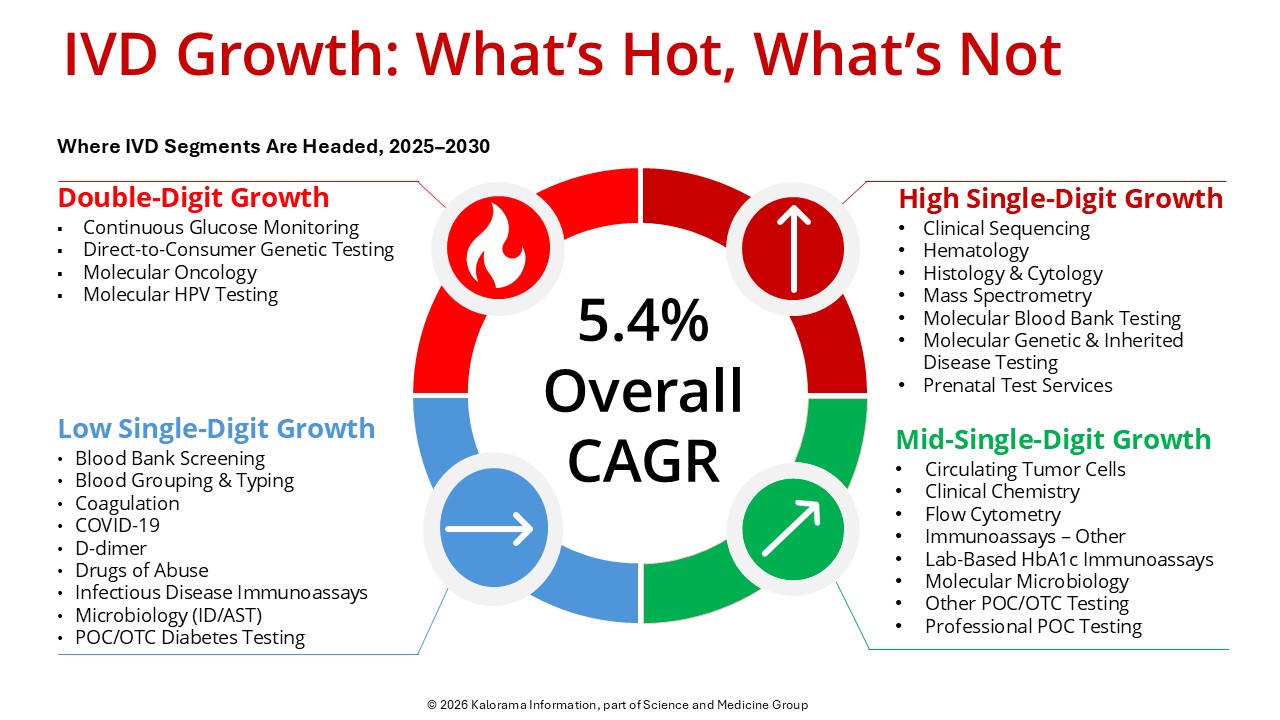
The top line first. The global IVD market reached $115.6 billion in 2025, up from just under $85 billion in 2020. Kalorama projects it will reach $150.4 billion by 2030, a 5.4% compound annual growth rate — a step down from the faster pace of the 2020–2025 window, and the slowdown is the point, not a disappointment.
“The number people fixate on is the top line, but the more revealing figure is the slope,” said Dr. Melissa Dueck, a senior analyst at Kalorama Information and co-author of the report. “We’ve come off the pandemic spike and onto a growth curve that’s actually sustainable. When growth normalizes like this, it stops being about volume and starts being about which technologies earn their place in the lab.”
A mature market where a few segments do the heavy lifting
Dig into the segment data and the concentration is striking. The top six categories — professional point-of-care testing, infectious disease immunoassays, non-infectious disease immunoassays (excluding HbA1c), continuous glucose monitoring, molecular microbiology, and clinical chemistry — together account for more than half of the global IVD market.
Most of those six are growing steadily at mid-single-digit rates and, in several cases, gradually ceding small slices of share. That’s the signature of a mature market: large, stable, and slow to move. The exception in that group is the one worth watching.
Continuous glucose monitoring is the clear growth engine, expanding at double digits and reshaping the market mix. Unlike traditional diagnostics, which are episodic and laboratory-based, CGM enables ongoing, real-time monitoring of a chronic condition, allowing earlier intervention and better disease management. Rising global diabetes prevalence, adoption that now reaches well beyond insulin-dependent patients, and steady wearable-device innovation are all pulling in the same direction.
“Continuous glucose monitoring is the segment that breaks the mature-market narrative,” Dueck noted. “It isn’t just a test anymore; it’s becoming the front door to remote monitoring and personalized care. That’s why it’s growing at a pace the rest of the core lab can only watch.”
Growth is concentrating in technology-driven, decentralized testing
CGM isn’t alone at the top of the growth chart. Molecular oncology, molecular HPV, and direct-to-consumer genetics are all posting double-digit expansion — all innovation-led markets. Meanwhile, more mature categories such as blood banking, coagulation, and traditional infectious disease immunoassays are growing at low single digits.
The through-line is clear: growth is increasingly concentrated in technology-driven and decentralized testing. Several trends reinforce this. Molecular oncology is moving beyond initial diagnosis toward minimal residual disease detection, where highly sensitive assays enable earlier relapse detection. Multiplex testing, once anchored to respiratory panels, is expanding into broader applications such as distinguishing bacterial from viral infection. Molecular transplant testing is returning to double-digit growth on the strength of HLA testing and next-generation sequencing. And sepsis testing continues to draw investment as biomarker-based approaches like PCT and lactate gain ground.
The geographic story: concentrated at the top, dynamic at the edges
Geographically, the IVD market remains highly concentrated. North America, Western Europe, and Japan together account for more than 70% of global revenue, and the United States alone represents over 40% of the market, sustained by high adoption of advanced diagnostics and leadership in high-value segments like molecular testing, CGM, and mass spectrometry.
Western Europe remains a core force, with Germany its standout — simultaneously the world’s second-largest IVD market and a genuine growth market, proof that maturity and opportunity aren’t mutually exclusive. Japan holds its position through a highly organized healthcare system, strong domestic manufacturing, and rigorous regulation. But these mature markets face real cost pressures and slower growth than developing regions.
That’s where the more dynamic story unfolds. Asia Pacific, which accounts for 16% of the global market, is led by China, India, and Japan, powered by large populations, aging demographics, and rising chronic-disease burdens. China continues to see solid underlying growth despite government cost controls, tied to the rising burden of diabetes, cardiovascular disease, and cancer. India, alongside Southeast Asia, offers some of the highest growth potential in the region, driven by expanding healthcare access, pharmaceutical exports, medical tourism, and consumer-driven testing.
Beyond the majors, several emerging APAC markets are worth watching: Southeast Asia broadly, with Indonesia and the Philippines benefiting from universal-healthcare expansion; Malaysia and Thailand drawing strength from medical tourism; and Singapore punching well above its weight as a molecular-diagnostics innovation hub.
Why South Korea keeps analysts’ attention
If one country crystallizes the theme of selective, technology-led growth, it’s South Korea. A top-25 market globally, it exerts influence far out of proportion to its size, serving as a hub for molecular diagnostics, AI-driven tools, and digital health innovation. Its advantage is an unusually integrated ecosystem — advanced hospital infrastructure, strong R&D, and world-class manufacturing that together enable rapid commercialization.
The pandemic was a defining moment. South Korea’s swift PCR deployment built lasting global credibility, and that expertise has carried forward into oncology and precision medicine, with genomics now widely adopted across leading hospital systems. Government policy is a meaningful tailwind, with targeted funding, regulatory support, and export initiatives cementing biotech as a strategic pillar of the national economy.
“South Korea is a case study in how a smaller market can be a benchmark for the whole industry,” said Dueck. “What impresses me isn’t a single year of fast growth but the consistency. South Korea is one of only two countries, alongside Brazil, to rank among the fastest-growing IVD markets in both our 2020 and 2030 views. A decade of sustained momentum is rare, and it’s exactly the kind of signal we tell clients not to ignore.”
The competitive landscape: concentrated, and consolidating further
The vendor picture mirrors the market’s overall shape. The top 20 IVD players account for nearly 80% of total share, with the remaining fifth fragmented across hundreds of smaller niche or regional companies. Abbott holds the global lead, anchored in point-of-care testing and a large CGM footprint, followed by a familiar roster of scaled competitors — Roche, Danaher, Thermo Fisher, Dexcom, Siemens Healthineers, bioMérieux, Illumina, Exact Sciences, and Sysmex.
Mergers, acquisitions, and partnerships continue to redraw the map. As diagnostics grow more integrated — spanning molecular testing, sequencing, immunoassays, and digital health — no single company can do it all, which makes dealmaking essential for filling capability gaps. Two 2026 transactions capture the direction of travel: the completion of the combination of BD’s Biosciences and Diagnostic Solutions business with Waters Corporation, and Abbott’s acquisition of Exact Sciences, which pushes Abbott deeper into cancer screening and precision oncology.
The bottom line for decision-makers
The IVD market of 2025–2030 rewards a different kind of attention than the pandemic years did. Aggregate growth is solid but no longer spectacular, which means the winners will be defined by where they place their bets, not by a rising tide. The opportunity is concentrating in three places at once: high-innovation segments like molecular oncology and CGM, decentralized and at-home testing models, and the faster-growing emerging markets where access is expanding rapidly.
“The barriers to adoption that defined the pre-pandemic era have come down, and that changes the calculus for everyone,” Dueck said. “The question is no longer whether advanced diagnostics will penetrate a market — it’s how fast, and who gets there first.”
This analysis draws on Kalorama Information’s 19th edition of The Worldwide Market for In Vitro Diagnostic Tests.